Anthropic has released a new product, and this time we will help you connect design and development
Anthropic's recent movement frequency is indeed a bit difficult to keep up with.
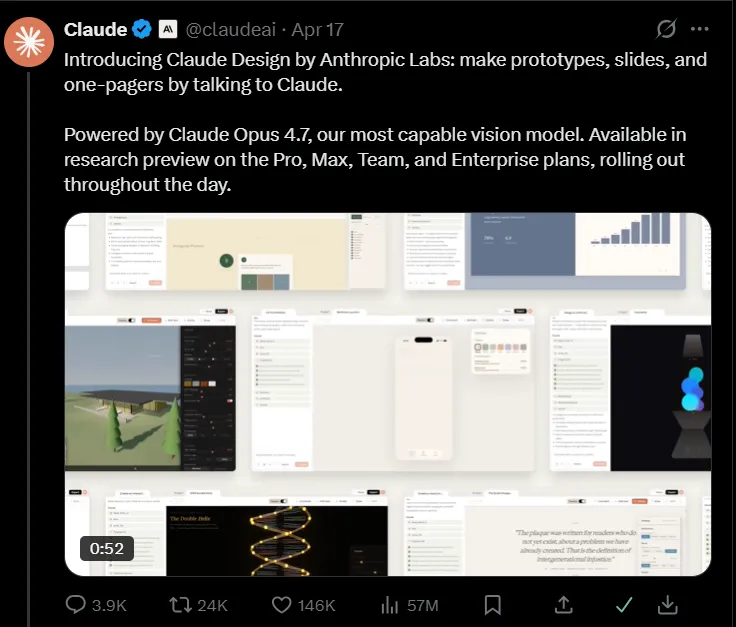
Claude Opus 4.7 was just released on April 17th, and the next day - April 20th - Claude Design was launched again. This new product solves a very practical problem:
What should we do if the designer is not in the team, or if the product manager has an idea to visualize quickly?
My previous choices were: either learn Figma by myself, find a designer to help, or use PPT to draw a rough prototype first. Neither option is very comfortable.
Claude Design's philosophy is: Whatever you say, it generates for you.
What can it do?
Let's talk about core competencies first.
Claude Design is driven by Anthropic's most powerful visual model, Claude Opus 4.7, and supports multiple input methods:
Pure text description: For example, "Design a peaceful mobile meditation app interface using soft color matching", it can generate corresponding design drafts for you.
Upload office documents: DOCX, PPTX, XLSX and other formats can be directly uploaded, which can read the document content and generate corresponding presentations or reports.
Point to the team code repository: Let it read your existing design system, color specifications, and component libraries, and it will uniformly use these specifications to generate new projects - rather than giving you a set of "generic but not team style" designs.
After generation, you can perform fine iterations through inline comments, direct text editing, and custom sliders (adjusting colors, spacing, layout, etc.). The entire process does not require learning any design software and is completed through dialogue.
The most eye-catching feature: One click submission to Claude Code for development
This feature is the killer move of the entire product.
After finalizing the design in Claude Design, you can easily package all assets, specifications, and comments with just one click and seamlessly hand them over to Claude Code for front-end development.
In other words, your process has changed from the previous three steps to two: requirements → design → development, without the need to tinker back and forth between tools.
For independent developers and small teams, this feature is of great significance. Previously, a product idea went from "having an idea" to "having a working demo", with two major stages in between: design draft and front-end development, requiring different people to do it. Now, AI has connected these two links for you.
What formats can be exported?
The generated design results support multiple export methods:
Canva: Continue fine editing in Canva after exporting
PDF/PPTX: Standard document format, directly used for presentations and proposals
Independent interactive HTML file: The generated file can be run and interacted with directly in the browser
In addition, it can capture elements from existing websites and generate prototypes that are closer to real products - not the kind of "generalized placeholder map", but truly grounded design solutions.
What is its positioning?
Anthropic made it clear that Claude Design is not meant to replace professional design tools like Figma, but rather to serve as an upstream creative engine, accelerating the early stages of creativity and iteration.
Its target users are:
Founder and Product Manager: Have ideas but no dedicated designer, quickly visualize ideas
Professional designer: Quickly explore early prototypes and leave high-value creative decisions to human hands
To put it simply, what it does is the process of "from 0 to 0.1", rather than the precise polishing of "from 0.1 to 1". Figma continues to do professional design, while Claude Design is responsible for quickly turning ideas into visible things.
What does it mean?
Claude's recent series of actions is forming a full stack capability chain covering idea → design → implementation:
Claude: Dialogue and Reasoning
Claude Code: Code Writing and Project Development
Claude Design: Visual Design and Prototype Generation
The combination of these three tools means that an entrepreneurial team can complete all stages from "having an idea" to "having a product that can run" within one ecosystem.
This is probably what Anthropic is really doing - not just an AI conversation assistant, but a complete set of AI productivity toolchains.