On July 25th, Midjourney officially announced the launch of the new generation image generation model V8.2. This update breaks away from the conventional iterative approach of simply improving resolution and optimizing text rendering, and focuses all research and development efforts on two core areas: upgrading the aesthetic quality of the graphics and matching personalized user preferences.
According to the official update announcement of Midjournal and the actual measurement report of overseas creators of Kie AI, V8.1, as the previous default model, although it has shown a striking performance in order to follow the instructions and the speed of high-definition mapping, there have been two major pain points of roast for a long time:
One is that the visual style tends to be flat and lacks distinct visual tension, resulting in randomly generated waste films with broken details and mediocre compositions;
The second issue is that personalized profiles do not capture users' aesthetic preferences accurately enough. Even if a large number of preference records are accumulated, the generated images still have a unified and universal template feel.
V8.2 completes targeted deep optimization, not only making the visual creativity, lighting, and composition more sharp, but also relying on massive image rating data from global users to reconstruct personalized training logic. The official also specially thanks the community creators for their long-term participation in image rating, which is supported by a large amount of artificial preference data for the dual upgrade of aesthetics and personalization.
Core optimization one: Comprehensive innovation in aesthetic texture, significantly reducing the probability of random low-quality waste films
The biggest headache for many designers and self media creators using Midjourney is "unstable card drawing": sometimes the same set of prompts can produce exquisite commercial grade images, while other times there may be waste films with imbalanced composition, fragmented light and shadow, and collapsed object structures, repeatedly redrawing and greatly increasing the time and cost of creation. V8.2 Solve this problem from the perspective of the underlying reward model.
The visual expression has a more creative edge, bidding farewell to the mediocre texture of the assembly line
The official has clearly defined the aesthetic upgrade standards for V8.2: the generated images are more creative, bold, and exquisite, with a sharp and fresh overall visual atmosphere, no longer a uniform balanced assembly line style.
The horizontal comparison of V8.1 shows significant differences in actual measurements:
Composition aspect: V8.1 is accustomed to a balanced and centered composition, with a conservative and soft image; V8.2 will actively use asymmetry, large depth of field, and extreme perspective to enhance the emotional and narrative sense of the picture;
Color and Light: Higher color contrast, clear distinction of light and shadow levels, stronger cinematic atmosphere, and no dull, low saturation images;
Detail texture: The material texture, hair strands, metal reflection, and texture depiction are more delicate, and there will be no large-scale blurring or edge sticking problems.
AI vision industry researcher Chen Yutong interprets the underlying logic: "Previous generations of Midjourney reward models tended to be more error free, balanced, and harmonious, deliberately suppressing creative expressions with tension and contrast; V8.2 Refactors the aesthetic reward dimension, incorporating visual impact and artistic uniqueness into the core scoring criteria. The model no longer deliberately pursues' steady and error free ', but actively produces more recognizable creative images. "
Random low-quality waste films are widely suppressed
The previous version had obvious randomness defects: even if the prompt words were complete and standardized, there was still a high probability of generating invalid images with structural errors, incomplete details, and fragmented atmosphere. V8.2 corrects noise scheduling logic based on massive community rating data, significantly reducing the probability of random output of low-quality images.
According to feedback from creators, the proportion of usable images generated for four consecutive times in the three high-frequency scenes of portrait, product still life, and scene space has increased by more than 60%, without the need for repeated redrawing and card drawing, directly reducing the creation time.
Core optimization 2: Comprehensive upgrade of personalized mechanism, more accurate recognition of your aesthetic preferences
Personalized Personalization is a core feature introduced by Midjourney in version 7, which relies on user ratings and ratings of images, trains exclusive aesthetic profiles, and generates personalized images using the -- p parameter. It is also an exclusive feature that distinguishes it from Stable Diffusion and DALL · E. V8.2 has comprehensively strengthened this system.
The more rating data there is, the more the model fits personal taste
The old version of personalization has shortcomings: even after completing hundreds of image ratings, the model is still prone to blending into general public aesthetics, and there is a large deviation in identifying niche styles and unique artistic preferences.
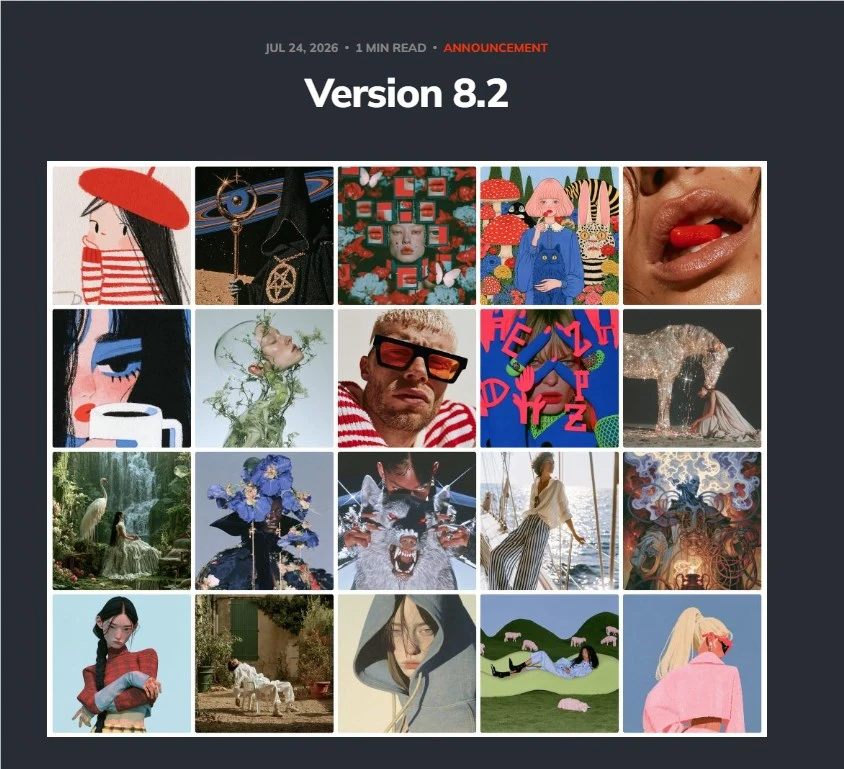
V8.2 optimized preference feature extraction algorithm can deeply capture subtle aesthetic tendencies hidden in users' long-term ratings: users who prefer niche styles such as retro film, dark surrealism, minimalist flatness, and Chinese ink wash can significantly improve the consistency of the generated image style after the file takes effect. The official emphasizes that the more accumulated image rating records under the account, the more significant the personalized effect improvement.
Build personalized files, optional image pool expansion optimization
When creating an exclusive aesthetic archive, the system will push a massive number of reference images for users to filter. The old version of the image pool has a narrow coverage of materials and serious homogenization of styles, making it difficult to accurately match niche creative needs.
V8.2 has expanded and optimized the image material library during the file creation phase, covering more art genres, shooting techniques, and material styles. Users can easily select reference images that fit their own creative habits and quickly train exclusive profiles with high recognition.
Official practical suggestion: Testing the combination of new and old personalized files
The Midjourney team has provided clear usage tips in the updated announcement: do not directly abandon the old personalized profiles built during the V8.1 period. It is recommended to test the old and new profiles separately with the V8.2 model.
There are differences in the training data and preference weights between the two sets of files. Alternating use can collide to create more differentiated styles, which is suitable for illustrators and concept designers to expand their creative materials and maximize the value of personalized functions.
Behind this update: Community rating data is the core driving force for iteration
Unlike many manufacturers that rely on internal laboratory data iteration, Midjourney V8.2's aesthetics and personalized optimization are based on core data from the community's free and open "Rank Images" image rating task.
Mechanism logic: Users rate paired images in the Tasks section of the official website and select works that better suit their aesthetic preferences. All rating data is aggregated and used to train the model's aesthetic reward module and personalized feature extraction module;
Official acknowledgements logic: At the end of this update, we specifically thank global creators for their long-term participation in image scoring and the massive amount of real human aesthetic preference data, which is the core foundation for upgrading the model's aesthetic ability;
Long term benefits: Users who continue to participate in image rating can not only accelerate the accuracy of their personalized profiles, but the platform will also give away Fast quick image output time as an incentive, forming a positive cycle of bidirectional optimization between the community and the product.
Compared with the core differentiation advantages of competitors, the focus of competition on the track has shifted towards aligning with human aesthetics
The current mainstream cultural and creative image models worldwide can be divided into two main routes: the open-source SD series focuses on custom LoRA and local deployment; Close source commercial models Midjourney, DALL · E 3, Flux 3 compete for native aesthetics and one-stop creative experience.
This V8.2 update further opens up the differentiation barrier of Midjourney in the commercial creative track:
DALL · E 3: Outstanding text comprehension ability, but the visual style tends to be realistic and universal, lacking strong artistic tension and no native personalized file mechanism;
Flux 3: Unified multimodal architecture with stronger physical logic and video generation capabilities, but personalized style matching requires manually uploading a large number of reference images and lacks a fully automated scoring training system;
Midjourney V8.2: Based on a million level user aesthetic rating database, it achieves personalized style locking out of the box, while significantly optimizing the artistic expression of the graphics, balancing commercial image efficiency and creative uniqueness.
Industry development trend: AI painting shifts from "restoring text" to "matching human aesthetics"
The iterative direction of Midjourney V8.2 releases three clear industry signals:
Simply upgrading image quality and resolution is no longer the core selling point
All head models can stably output 2K high-definition images, and the gap in hardware computing power and diffusion architecture continues to narrow. Whether they can accurately capture human subjective aesthetic preferences has become the key to distinguishing product competitiveness.