
After AI programming tools enter the code repository, security issues also begin to move forward.
OpenAI recently launched the open-source command-line security tool Codex Security CLI. Public information shows that it is aimed at authorized code repositories, supports code scanning, vulnerability tracking, and automated security checks, and can help developers discover, verify, and track security issues in local command lines or CI/CD processes.
This matter is worth paying attention to, not only because OpenAI has launched another developer tool, but also because AI Coding is transitioning from "helping you write code" to "helping you maintain code quality and security boundaries".
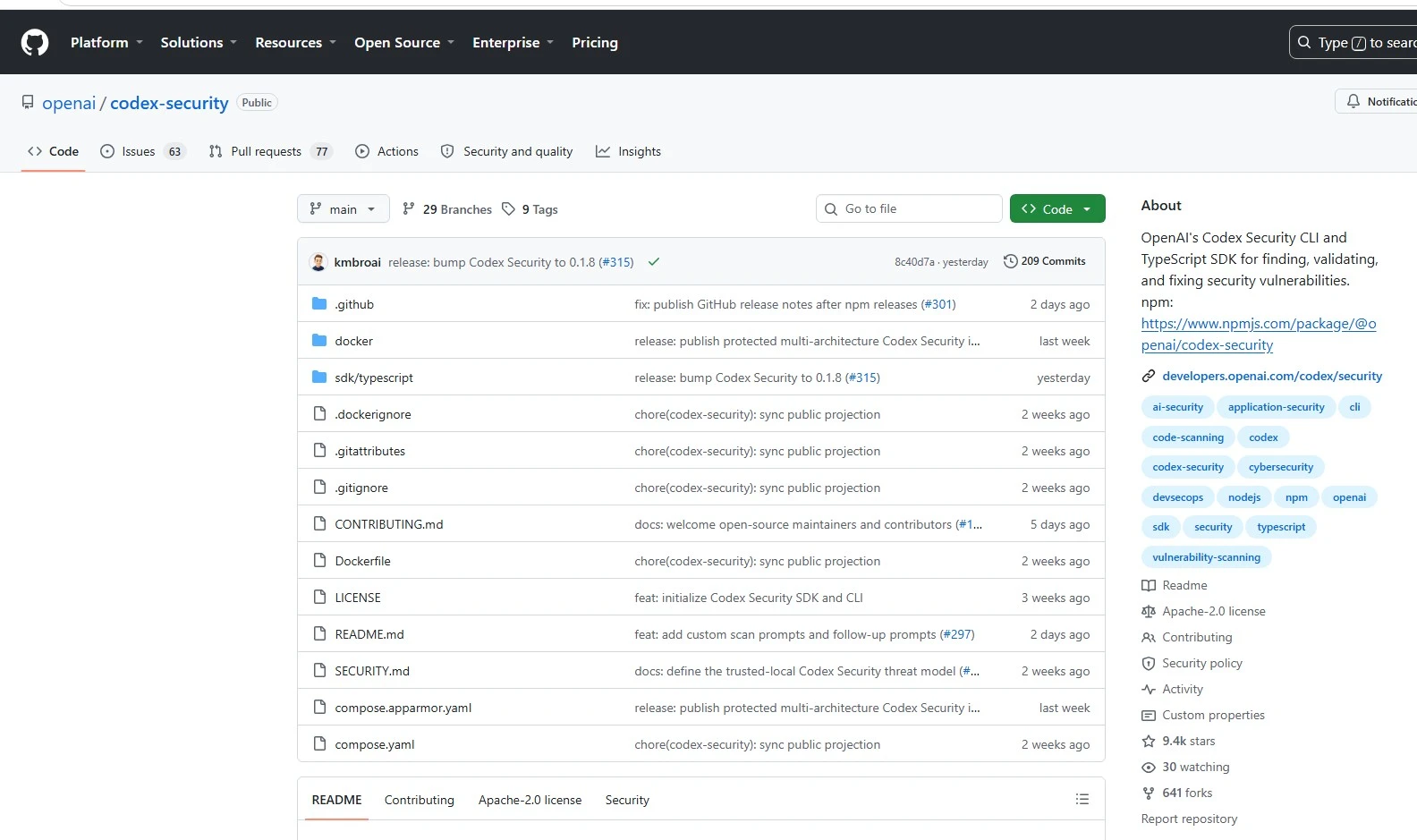
Why do we need a secure CLI?
In the past, security checks often occurred in the later stages of the development process: code completion, feature merging, pre launch scanning, and even retrospective investigation after accidents occurred.
But after AI participated in coding, the pace became faster. Developers can generate a feature, modify a batch of files, add an interface within minutes, or introduce dependencies, permissions, input validation, injection risks, and configuration issues simultaneously.
At this point, if security tools only intervene in the last step, they will become increasingly passive.
The significance of the Codex Security CLI is to put security checks back into the developer workflow: developers can scan the repository on the command line, check for changes before merging the code, track findings between multiple runs, and integrate security checks into automated processes.
It is not a 'chatbot', but more like a security checkpoint that can be embedded in engineering links.
What is its relationship with Codex Security?
According to OpenAI's official introduction, Codex Security is an application security agent that is currently in the research preview stage and is open to users such as ChatGPT Enterprise, Business, Edu, Pro, etc. It can connect to GitHub repositories, build code repository context and editable threat models, and execute a closed loop around vulnerability identification, validation, repair recommendations, manual review, and revalidation.
The Codex Security CLI further extends this capability to the command line and automation scenarios.
Public information shows that the core values of CLI include:
Scan authorized code repositories;
Track security findings across multiple runs;
Check for changes before code integration;
Support integration into CI/CD automation processes;
Provide local entry points with lower friction for developers.
It should be noted that the official statement emphasizes that Codex Security will not automatically modify the code. It can generate patch suggestions, but still requires manual review and enters the repository through the normal PR and code review process.
What really matters is' verifying vulnerabilities', not just reporting risks
Many security scanning tools have issues with multiple alarms, false positives, and unclear priorities. The development team did not end up without tools, but was overwhelmed by the police.
A key idea of Codex Security is to enable agents to reproduce and verify vulnerabilities in isolated environments, minimize false positives, and provide repair recommendations that are closer to engineering capabilities.
This is important for the development team. Because security alerts only have value when they enter the engineering closed loop:
Can you understand the context of the code repository?
Can we determine if the risk can really be triggered?
Can vulnerabilities be associated with submission history, file location, and repair suggestions?
Can developers identify issues before merging?
If these links can be partially undertaken by automated tools, the security team can shift from "manually flipping alerts" to "reviewing high-value discovery and repair solutions".
What does it mean for the team? Safe Left Shift Enters AI Coding Era
For individual developers, the Codex Security CLI can become a local security check tool: after writing the code, run it once to see if there are any obvious vulnerabilities, dangerous dependencies, or high-risk changes.
For enterprise R&D teams, it is more suitable to be placed in the engineering governance system:
Local development: Scan for key changes before submission;
Pull Request: Perform automated security checks on newly added code;
CI/CD: Incorporate scan results into merged access control;
Security team: Track vulnerability discovery, repair status, and duplicate risks;
Management: Put the speed and security governance of AI coding in the same table.
Behind this is a trend: AI not only writes code, but also participates in code review, test generation, security checks, and defect fixes. The future software delivery pipeline will increasingly resemble a collaborative system of "development agent+testing agent+security agent".
But it cannot replace the safety manager
We also need to exercise restraint. The Codex Security CLI is still in its early or beta stage and may require access permissions to use; The installation method, Node/Python environment requirements, authentication method, CI configuration, and availability range may all change with official updates.
More importantly, no automated security tool can promise zero false positives or false negatives, nor can it replace the security manager's judgment on business risks, permission boundaries, data compliance, and deployment strategies.
The correct posture is not to "let AI automatically fix vulnerabilities", but to let AI help the team discover problems earlier, reproduce problems faster, generate repair suggestions more clearly, and ultimately have humans complete the review, selection, and merging.
The emergence of the Codex Security CLI indicates that the competition in AI coding is continuing to extend backwards.
In the past, people were concerned about whether AI could write code. The more critical issue now is whether the code written by AI can be checked, validated, and safely integrated into the production process.
From this perspective, Codex Security CLI is not an isolated tool, but a piece of the puzzle in the AI software engineering chain. It moves security capabilities from the audit phase to the development phase, allowing agents to participate in vulnerability discovery, tracking, and repair recommendations.
The faster AI writes code, the more automated, streamlined, and traceable security checks are needed.
This may be the most noteworthy aspect of Codex Security CLI.