The model of crayfish with fire is finally going to be open sourced
To be honest, when I saw this news, my first reaction was: it's finally here!
I think the open-source trend of MiniMax 2.7 is quite interesting. Why? Because its path to success is different from other models - it didn't rely on overwhelming promotion, but on a plugin called OpenClaw. This plugin is nicknamed 'Crayfish', it sounds quite down-to-earth, right?
It was this "crayfish" plugin that made MiniMax 2.7 popular in the developer community. Do you think this is a stroke of luck? I think it's quite interesting. A technological product that relies not on official promotion, but on user initiated dissemination, itself indicates that it is indeed useful.
Now the official announcement is that an open source version will be released this weekend. I think the timing is also quite good - not hiding anything, just opening it up and allowing more people to play.
What is the performance really like? Data speaks for itself
I know many people may have some doubts when they see the four words "domestic model": is it reliable?
Let's just look at the data and not play games.
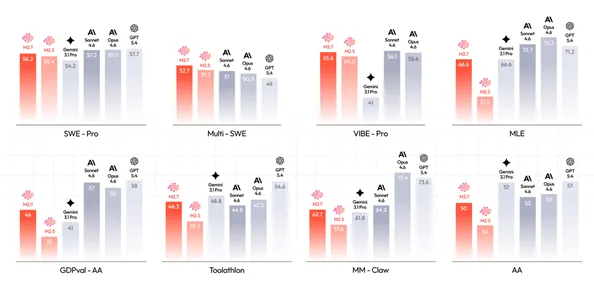
In the SWE Pro benchmark test, MiniMax 2.7 scored 56.22%. What is the concept of this score? It is close to the level of the top model Opus. To be honest, I was quite surprised when I looked at this data. I didn't expect the gap to be so close.
There is also an ELO score called GDPval AA, with MiniMax 2.7 scoring 1495, ranking among the top in open source models. This score may sound a bit abstract, but in simple terms, it is already in the first tier of the open source race.
In addition, in the MMClaw review, its performance has approached the latest Sonnet 4.6. You should know that Sonnet is one of Anthropic's leading actresses, and being able to argue with her is quite indicative in itself.
Writing code and fixing bugs, it's really capable of this job
As a technology self media, I also write some code on a regular basis, so I pay special attention to this aspect.
MiniMax 2.7 performs exceptionally well in bug analysis, code security, and end-to-end project delivery. Note that when I say 'excellent', it's not 'okay'.
What is end-to-end project delivery? Simply put, if you give it a requirement, it can help you get the project done from start to finish, not the kind of tool that can only write a few lines of code snippets. I think this ability is really practical for developers.
And it also has a skill: the compliance rate of complex skills in long text scenes can reach up to 97%. What does this number mean? You give it a long task with a bunch of requirements, and it can follow your rules without running off track. To be honest, this ability is quite rare. Many models start to unleash themselves as long as the text is long.
Office software can also be played smoothly
I think this is quite surprising.
MiniMax 2.7 has significantly improved the complex editing capabilities of Excel, PPT, and Word. Note that it is' complex editing ', not simply changing text or adjusting formatting.
Let me give you an example. If you ask it to help you make a PPT, it's not the kind that randomly sets templates, but the kind that has real content, logic, and decent layout. It can help you organize it. Excel is also capable of handling complex data processing and formula calculations.
For ordinary users, I think this ability is more practical than writing code. After all, not everyone is a programmer, but almost everyone has to deal with Office. It's quite satisfying to think about an AI that can help you with office software.
Identity consistency is quite crucial
There is another ability that I think is particularly worth mentioning: excellent identity consistency.
This sounds a bit abstract, let me explain. When you are talking to it, it plays a role and can always maintain the setting of that role, without playing or breaking the character's image.
What is the use of this ability? As mentioned in the material, there is ample creative space reserved for interactive entertainment and role-playing applications. I think this direction is quite interesting. Nowadays, AI role-playing and AI companionship applications are quite popular, but if AI forgets who they are while chatting, the experience will be very bad.
MiniMax 2.7 is well done in this area, which means you can use it with confidence to create various role-playing applications without worrying about it suddenly jumping off the screen. I think this ability is a difficult problem that many models are still striving to overcome.
The significance of open source: It's not just about saving money
Finally, I would like to talk about open source.
As mentioned in the material, the open-source MiniMax 2.7 will allow developers to flexibly deploy on different platforms. I think this is particularly important.
When Anthropic previously restricted third-party access to OpenClaw, MiniMax explicitly stated its support for cross platform use. The official attitude is that excessive restrictions will stifle innovation. I think this stance is quite appropriate.
What does open source mean? This means that more platforms can directly run MiniMax 2.7, and developers can enjoy more cost-effective keyword fees. Simply put, it means saving money, but I think the significance goes beyond that.
Open source means you can deploy, control, and customize it yourself. Don't worry about the service provider suddenly changing rules, raising prices, or restricting access one day. For developers, this sense of security is very important.
And after open source, the power of the community can be unleashed. If there are problems, let's fix them together. If there are requirements, let's add them together. This iteration speed is difficult to compare with closed source products.
I think MiniMax's wave of open source is also a statement to some extent: we are willing to stand with developers, rather than locking technology in a cage. I quite appreciate this attitude.