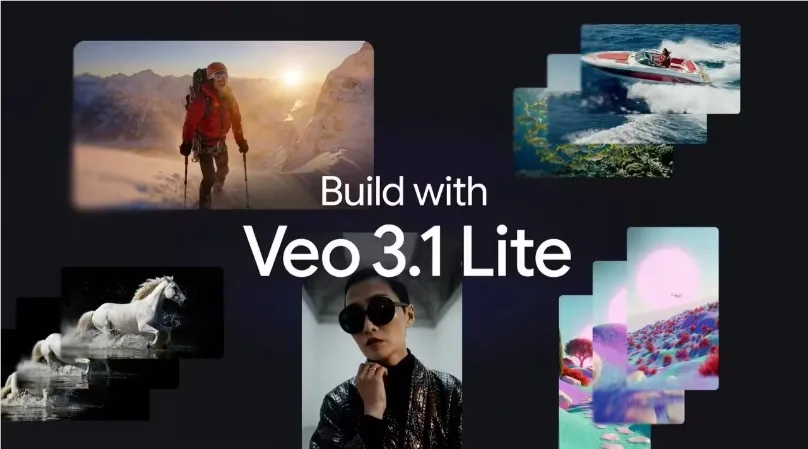
Google DeepMind officially released its most cost-effective video generation model to date, Veo3.1Lite, on March 31, 2026. This model reduces operating costs by more than half while maintaining the same generation speed as Veo3.1Fast - only $0.05 per second at 720p resolution and $0.08 per second at 1080p version. This pricing strategy marks the acceleration of video generation technology from the "technology display stage" to the "large-scale commercial application stage".
Technological Breakthrough: How to Achieve Cost Reduction?
The core breakthrough of Veo3.1Lite lies in the technological implementation of "equal speed, half cost". According to official information, this is likely to be achieved through model distillation or architecture optimization. Model distillation refers to compressing the knowledge of a large model into smaller models, significantly reducing inference costs while maintaining core capabilities; Architecture optimization may involve more efficient network structure design.
From a technical perspective, Veo3.1 Lite supports video clip generation of 4 to 8 seconds, covering both text to video and image to video dual paths, and adapting to various frame requirements such as vertical and horizontal. This means that developers can quickly generate video content that is suitable for various scenarios such as short videos, social media, advertisements, etc. at an extremely low cost.
Pricing strategy: Google's business calculation
Google's pricing this time is not simply a "price reduction promotion", but a carefully considered business strategy. Firstly, low-priced entry can quickly expand the user base, cultivate developers' habits of using the Veo series, and build an ecological moat. Secondly, Google announced that it will lower the overall price of Veo3.1Fast from April 7th, reducing the 4K resolution generation cost to $0.30 per second, indicating that its pricing adjustment is systematic and sustainable.
More importantly, Veo3.1Lite has been integrated into Gemini API and Google AI Studio, which means developers can complete the entire process from text generation to video generation in one stop within Google's AI development ecosystem. This ecological synergy effect is a competitive advantage that cannot be replicated by simply lowering prices.
Market timing: Precise card position Sora vacuum period
This strategic move coincides with OpenAI's announcement of the closure of the Sora project during a market vacuum period. As OpenAI's flagship video generation product, Sora's shutdown has left valuable market gaps for competitors. Google is launching cost-effective products at this time, with a clear intention of precise positioning.
Against the backdrop of intensified competition in the global video generation field, Google is also facing strong challenges from the Chinese market. Alibaba's Seedance2.0 and other models have shown strong competitiveness in terms of image quality performance, which requires Google to respond through differentiation strategies. Choosing "cost advantage" instead of simply "image quality competition" as a breakthrough reflects Google's precise insight into market demand - for most commercial application scenarios, cost efficiency is often more decisive than ultimate image quality.
Industry Impact: Commercialization Turning Point Has Arrived
The pricing adjustment of the Veo series marks a crucial turning point in the development of video generation technology. When the generation cost drops to the order of a few cents per second, the application scenarios of video AI will expand from "high-end demonstrations" to "large-scale production". The fields of e-commerce short videos, social media content, educational videos, advertising materials, etc. may all usher in the large-scale popularization of AI video generation due to cost reduction.
For developers, low cost and high efficiency will be the core considerations when choosing a base model. When the cost of generation is no longer a limiting factor, creativity and content themselves will become the focus of competition, which will drive the entire industry from being "technology driven" to being "content driven".
Future Development: The Next Stop for Video AI
In the short term (3-6 months), it is expected that more competitors will follow suit and lower prices, and the price war in the video generation market may accelerate industry reshuffle. In the long run (1-3 years), video generation technology may become the infrastructure for digital content production, together with text generation and image generation, forming a complete toolchain for AI content creation.
For Google, the success or failure of Veo3.1 Lite is not only related to the market performance of a single product, but also to its overall competitiveness in the AI development ecosystem. When video generation becomes a standard feature of AI applications, whether Google can consolidate its developer ecosystem advantage through this is worth continuous attention.