On January 7, 2026, Jerry Tworek, Vice President of Research and one of the founders of OpenAI, officially announced his resignation. Known as the "father of reasoning models," Jerry had been deeply involved in the company for nearly seven years. He chose to embark on a new scientific research journey because he wanted to explore research directions that were difficult to support in OpenAI's current environment. His resignation sparked widespread discussion in the AI industry about the balance between scientific research and commercialization.

Jerry Tworek shared his decision to resign through social media, with the core details and background as follows:
Duration of employment and role: Having served at OpenAI for nearly seven years, I am the Vice President of Research and a member of the company's core founding team. I have led the development of multiple key technologies and am known as the "Father of Reasoning Models";
Reason for leaving: The individual explicitly stated that they will explore research topics that are difficult to conduct within OpenAI, without disclosing the specific research direction. However, industry analysts believe that this may be related to OpenAI's strategic shift towards commercialization and productization in recent years, as they prefer to delve deeper into pure research fields;
Emotional expression: In the farewell letter, the individual reflects on the wonderful experiences during their tenure, expresses gratitude for the time spent working with a talented team, thanks the company and colleagues for their trust, and candidly admits that leaving was a difficult decision. They highly praise OpenAI as "a company with a special place in human history".
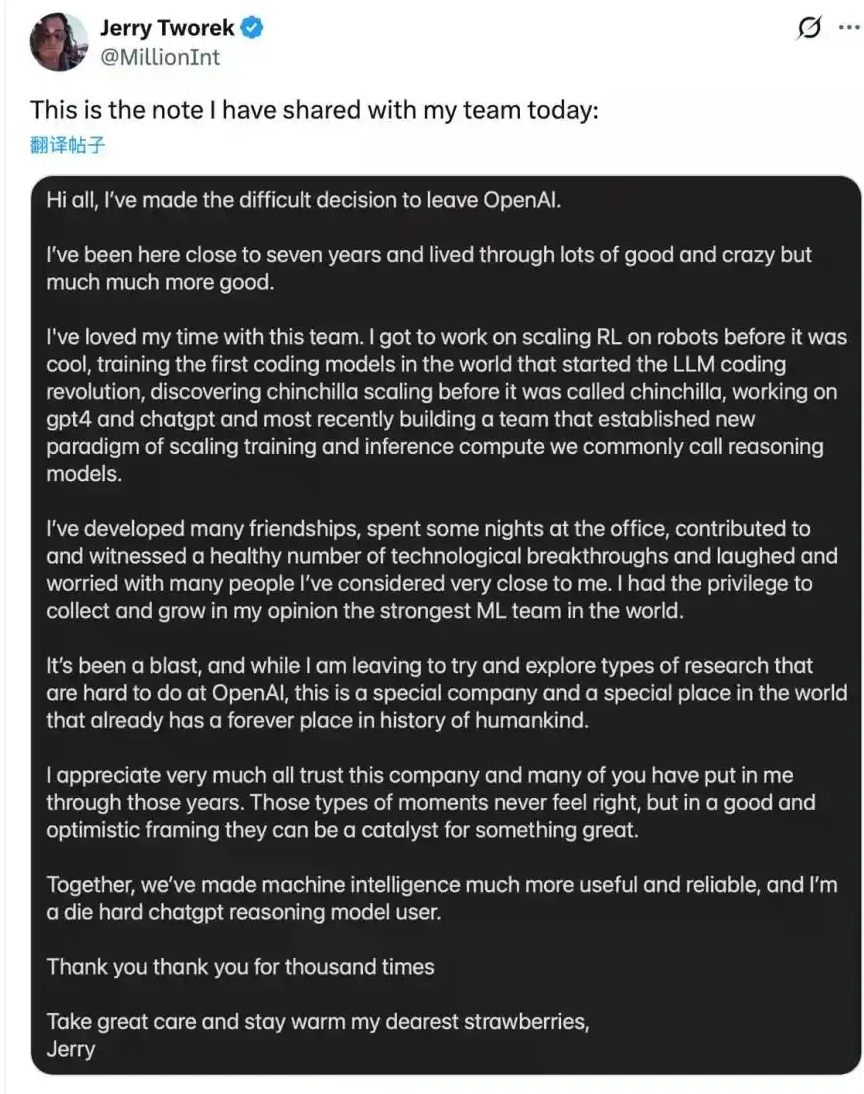
During his tenure at OpenAI, Jerry Tworek participated in and led multiple major projects that have influenced the development of the AI industry, with core contributions focusing on three major areas:
Core Model Development: Led and participated in the technical development of GPT-4 and ChatGPT, and spearheaded the construction of the Codex code model and O1/O3 inference models. Codex, as the world's first large-scale applied coding large model, initiated the coding revolution of LLM (Large Language Model);
Exploration of technological breakthroughs: Taking the lead in conducting large-scale research on robotic reinforcement learning at a stage when it has not yet become widespread; participating in the discovery of the core logic of the "Squirrel Scaling Law" before it was named, providing crucial support for optimizing the training efficiency of large models;
Team building and accumulation: Established and nurtured what is considered "the world's strongest machine learning team" within OpenAI, laying the foundation for the company's technological iteration and talent pool. The reasoning model research and development paradigm led by him still influences the industry's technological trajectory to this day.
As a core member of the founding team of OpenAI, Jerry Tworek's departure is not just a single talent turnover within a company, but also reflects a common issue in the development of the AI industry at this stage:
The dilemma between scientific research and commercialization: As leading AI companies such as OpenAI accelerate the commercialization of their technologies, the resource allocation for pure basic scientific research may be affected. Some researchers who focus on cutting-edge exploration may face the dilemma of "limited direction". This departure may become a signal of talent turnover in the industry;
Diverse Possibilities for Technological Innovation: The industry widely anticipates that after leaving the corporate framework, Jerry Tworek is expected to explore disruptive technologies in a freer scientific research environment. His profound accumulation in areas such as reasoning models and code models may bring new breakthrough directions to the AI industry;
Industry norm of talent turnover: The rapid development of the AI industry is accompanied by the turnover of core talents. This turnover may inject vitality into new teams, but it may also pose challenges to the technological inheritance of leading enterprises. It is worth paying attention to how OpenAI will fill the technological and managerial gaps left behind.
The departure of Jerry Tworek is a microcosm of the dynamic adjustment of the research ecosystem in the AI industry. Driven by both technological iteration and business development, the choice of core talents will continue to influence the industry landscape. Whether it is to stay within the enterprise and delve deeply into applications, or to break out of the framework and explore the frontier, diversified research paths will provide impetus for the advancement of AI technology.