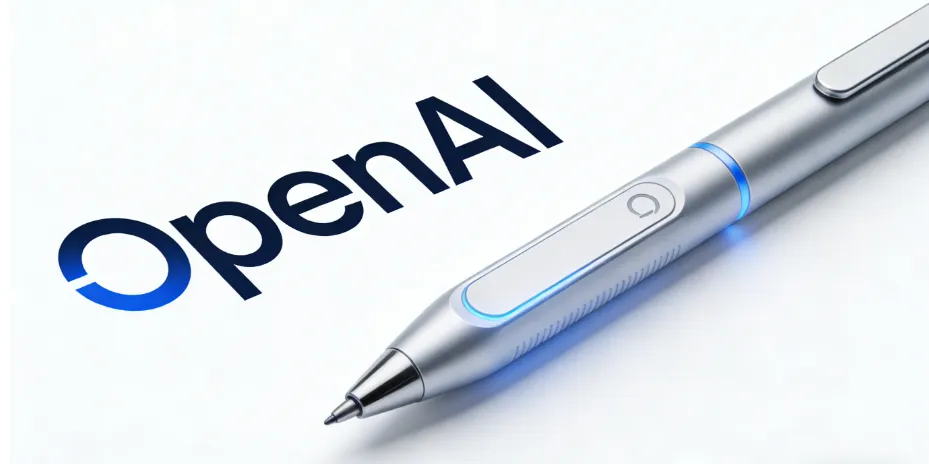
On December 31, 2025, according to social media leaks and industry information integration, there was new development in the first AI hardware project between OpenAI and former Apple Chief Design Officer Jony Ive. The project, codenamed "Gumdrop", is rumored to be either a smart pen or a portable audio device, and Foxconn has been confirmed as the contract manufacturer.
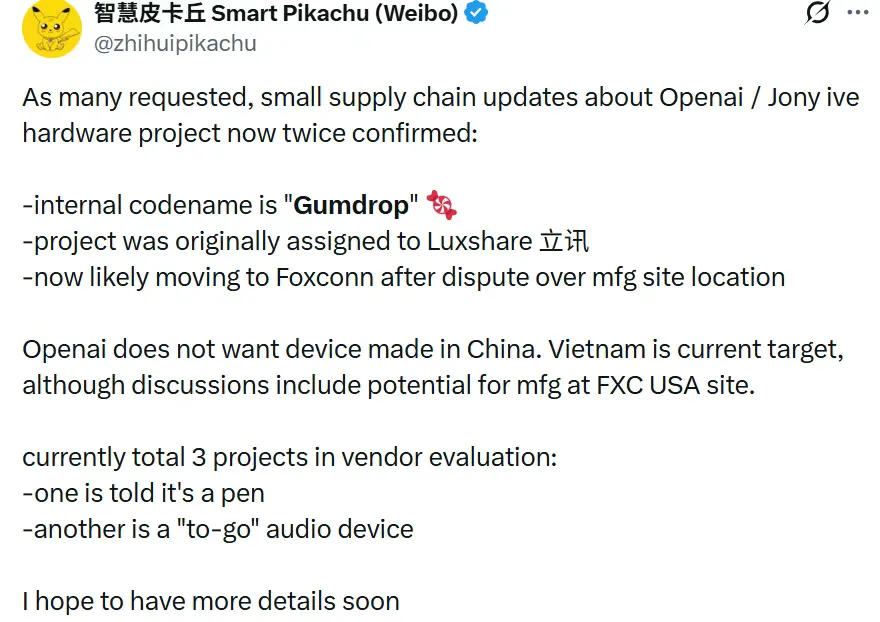
As a major project for OpenAI's layout of consumer-grade AI hardware, the supply chain and production planning for "Gumdrop" have been clarified:
Exclusive code name: Internally named "Gumdrop", it serves as the core vehicle for OpenAI to break through the barriers of pure software and enter the AI hardware arena.
Contract Manufacturing Transition: Initially, Luxshare Precision was chosen as the contract manufacturer. However, due to a dispute over the manufacturing location, the partner was adjusted, and Foxconn was ultimately selected. With its mature assembly experience in products such as the iPhone and Pixel phones, Foxconn provides support for the mass production of AI hardware.
Production site planning: Prioritize the establishment of a production base in Vietnam, with Foxconn's factory in the United States as an alternative plan. The layout of production sites should balance cost and market adaptability needs.
This AI hardware is positioned with "portability + AI empowerment" as its core, presenting two major directions in form and function:
Smart Pen Form Factor: The core functionality focuses on efficient interaction, supporting real-time transcription of handwritten notes and synchronizing them to ChatGPT. It facilitates the entire process from "handwriting input - AI processing - digital storage", adapting to various scenarios such as office work and learning.
Portable audio device: It primarily features on-the-go AI interaction, with a size comparable to the iPod Shuffle. It supports carrying via a necklace or in a pocket, and can achieve two-way voice communication by pairing with a smartphone and ChatGPT, thereby lowering the barrier to using AI tools.
Additional configuration: According to foreign media reports, the device may be designed without a screen, equipped with microphones and cameras, and possess scene perception capabilities, enhancing the immersion of AI interaction.
The performance of AI hardware is closely related to chips, and the dynamics of the supply chain present key highlights:
Potential suppliers: The industry generally speculates that Qualcomm is the core candidate - Intel, AMD, and NVIDIA have insufficient layouts in the field of extremely low-power chips, and MediaTek's ecosystem and baseband quality are difficult to match the demand. However, the upgraded version of Qualcomm's Watch/AR series chips can meet the low-power requirements for cloud + local small model operations.
Industry response: Chip manufacturers attach great importance to cooperation with OpenAI and are actively seeking opportunities for collaboration. They do not rule out the possibility of customizing exclusive AI chips for the project, and the competition in the supply chain is intensifying.
The advancement of this AI hardware will introduce new variables to the competitive landscape of the AI industry:
R&D progress: In an interview, Sam Altman, CEO of OpenAI, and Jony Ive confirmed that the first prototype of the hardware has been developed and is planned to be officially launched within two years. The R&D progress is steadily advancing.
Industry background: The current consumer-grade standalone AI hardware market has not yet formed a mainstream trend, with early products such as Rabbit R1 and Humane AI Pin receiving lukewarm market responses. However, leveraging its advantage in large models, OpenAI is expected to build a closed loop of "hardware + AI ecosystem", providing new development ideas for the AI hardware sector.
OpenAI's foray into AI hardware not only enriches the forms of AI products but also propels the industry to explore more diverse AI interaction modes, injecting new vitality into the dynamic of the AI industry.