On January 6, 2026, during the keynote speech on the first day of the CES exhibition, NVIDIA CEO Huang Renxun announced that the new generation of Rubin chips has officially entered mass production, significantly ahead of market expectations. This new product, which focuses on AI supercomputing, not only achieves a dual breakthrough in performance and cost-effectiveness, but also marks the official arrival of the "ChatGPT moment" for physical AI, injecting key variables into the AI industry dynamics and providing core computing power support for AI tool innovation and AI creation ecosystem upgrading.
As Nvidia's core product for next-generation artificial intelligence, Rubin chips have achieved disruptive improvements in core metrics. Compared to the current mainstream Blackwell architecture, Rubin achieved three key breakthroughs by training a hybrid expert (MoE) model in parallel with 4x GPU:
Training efficiency: The training speed of large models has been increased by 3.5 times, significantly reducing the development cycle of AI models;
Cost control: Reduce the average inference cost of each token by 10 times, helping to popularize AI technology at low cost;
Energy efficiency optimization: The inference ability per watt of electricity is increased by 8 times, balancing performance and green computing needs.Huang Renxun emphasized that Rubin's core advantage lies not only in its ultimate performance, but also in its cost-effective feature of "accelerating the landing of mainstream AI applications at the lowest cost". This feature will effectively meet the cost control needs of the AI industry and pave the way for the large-scale application of various AI tools and AI creation scenarios.
2、 Architecture analysis: Six core collaborative construction of AI supercomputing platform
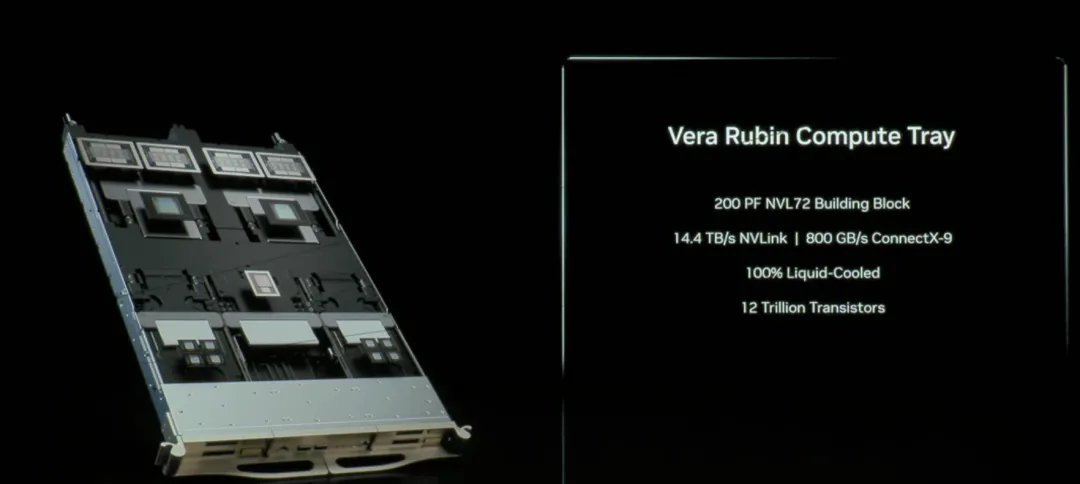
The Rubin platform adopts a collaborative architecture design, consisting of six core chips to form a complete ecosystem, namely NVIDIA Vera CPU, Rubin GPU, and NVLink ™ 6 switches ConnectX-9 ® SuperNIC、BlueField-4 ® DPU and Spectrum-6 ™ Ethernet switch. Through ultimate collaborative design, each component forms an efficient computing power network, specifically optimized for large model training and inference scenarios, which can fully unleash the potential of AI computing and provide stable and efficient computing power support for complex AI tasks, adapting to the full scenario requirements from AI creation to industrial grade AI applications.
Currently, the competition in the AI chip market is becoming increasingly fierce, and ASIC chips represented by Google TPU are rapidly rising. Its expected growth rate of 43% is significantly higher than GPU's 15%, and its market share will also increase from 41% to 46%, posing a challenge to Nvidia's market dominance. In this context, Rubin's early mass production has become a key measure for Nvidia to consolidate its advantages, and its strong product strength has also won widespread market recognition.
According to Huang Renxun, AWS、 Google, Microsoft Meta、OpenAI、Anthropic、 Dell, Lenovo, and other top global cloud providers, large model enterprises, and hardware manufacturers have all expressed their intention to deploy. The luxury customer lineup has laid a solid foundation for Rubin's market promotion and will further promote the collaborative development of the AI industry ecosystem.
In addition to releasing the Rubin chip, Huang Renxun also outlined the development path of artificial intelligence: gradually evolving from the current generative AI to autonomous agent AI, and ultimately moving towards physical AI that can interact in the real world. 2026 is defined as the "first year of agent AI", which will fundamentally change the application mode of enterprise level AI.
To promote the implementation of physical AI, Nvidia has simultaneously released multiple new products, including the autonomous driving model Alpamayo with autonomous thinking and reasoning capabilities, the upgraded Cosmos model, and the GR00T open model and data. At present, companies such as Boston Dynamics, Caterpillar, LG Electronics, etc. have begun to develop a new generation of AI robots based on NVIDIA's robot technology stack, and the commercial application of physical AI is accelerating.
It is worth noting that due to the US government's restrictions on the export of high-end GPUs to China, Chinese cloud vendors and large model developers are temporarily unable to directly deploy Rubin and Blackwell architecture products locally. This restriction may affect the deployment pace of related domestic enterprises in the field of AI high-end computing, and also bring new opportunities and challenges for independent innovation in the domestic AI chip industry.
The early mass production of Rubin chips is not only an important measure for NVIDIA to consolidate its leadership position in AI chips, but also to promote the upgrading of global AI computing infrastructure, accelerate the transition of physical AI from technical concepts to practical applications, and provide stronger underlying support for AI tool innovation, AI creation upgrades, and other scenarios. With the intensification of industry competition and continuous technological iteration, the AI chip market will usher in a new pattern reshaping, and the rise of physical AI will also open up new development space for the AI industry.