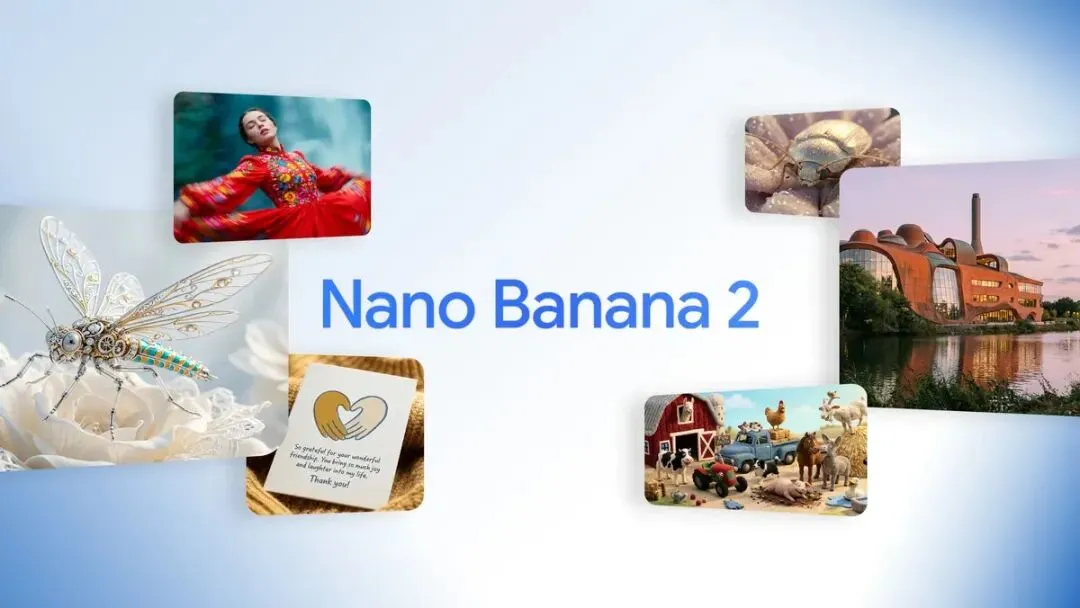
AI generated graphics circle welcomes a heavyweight explosion! On February 27, 2026, Google DeepMind officially launched the new generation image generation model Nano Banana 2 (Gemini 3.1 Flash Image), which will be simultaneously launched on Google Gemini applications, search, AI Studio and other products. This model, which combines Pro level image quality and Flash level speed, not only achieves 4K generation and solves classic problems, but also directly cuts the generation price by half. Once launched, it will dominate the charts with its strength, redefining the cost-effectiveness ceiling of AI generated images.
Core Upgrade: Fast, Accurate, and Efficient, Three Highlights Directly Targeting Industry Pain Points
Unlike its predecessor's simple iterations, Nano Banana 2 can be regarded as a comprehensive engineering upgrade, with three core advantages of "fast, accurate, and cost-effective", accurately solving the speed, accuracy, and cost problems of AI mapping, becoming its key confidence in gaining popularity.
• Speed up: Inheriting the genes of Gemini Flash series, it can generate 4K high-definition images in just 1 minute of testing, with a focus on high-speed response, perfectly adapting to commercial creative scenarios that require rapid iteration, and bidding farewell to long waiting times;
• Precision leap: greatly optimized the problems of Chinese garbled characters and text rendering distortion, significantly improved the understanding of traditional Chinese culture, and successfully solved the "clock generation problem" that has plagued the industry for a long time. It can accurately restore specific clock displays such as "21:35" and achieve full command compliance;
• Cost cutting: The cost-effectiveness is directly maximized. On the Google AI Studio platform, the unit price of output images has dropped from $0.134 for Nano Banana Pro to $0.067, and the unit price of input images has dropped from $2 to $0.5. Increasing the quantity also reduces the price, significantly lowering the comm
Tested experience: Full attention to detail, flaws do not overshadow the strength of the raw image
Industry media conducted on-site testing of Nano Banana 2 for the first time, and its performance far exceeded expectations. It achieved cross generational improvements in detail restoration, scene adaptation, and other aspects. Although there were slight shortcomings, its overall strength can be regarded as the top tier in the animation industry.
In terms of detail rendering, Nano Banana 2 performs impressively: when generating a close-up of a 60 year old Asian fisherman, it can accurately restore wrinkles, sunspots, and pores on the face, and the details refracted by sunlight are also vivid, far ahead of the Pro version; When generating the scene of "giant pandas writing calligraphy", the panda's fur is threaded tightly, the pearl like texture of the Beijing opera headwear is realistic, and the brush strokes of the "generative AI" are smooth, with only a few strokes slightly non-standard.
In complex scene processing, its advantages are more obvious: when shooting ballet dancers soaring in the air from above, it can accurately control facial proportions and perspective relationships without any distortion; When replacing vehicles in the parking lot, the original style can be maintained, and the proportion of vehicles and light shadows fully comply with physical laws; It can even handle interactive scenes with multiple people, restoring the delicate emotions of newlyweds with tears in their laughter, with only slight flaws in the refraction effect of tear fluid.
Ecological layout+performance ranking, Google restructures the landscape of the production map track
In terms of performance, Nano Banana 2 has performed outstandingly in benchmark tests, significantly surpassing mainstream models in the industry such as GPT Image 1.5 and Seedream 5.0 Lite. Coupled with its thinking mode and text image search tool, it has also comprehensively surpassed the previous generation Nano Banana Pro, firmly entering the first tier of life graphics.
In terms of ecological deployment, Google has also demonstrated a strong strategic layout: Nano Banana 2 has fully replaced the Fast, Thinking, and Pro versions of Nano Banana Pro in Google Gemini applications, and Pro and Ultra subscribers can choose to use it on demand; Simultaneously logging into developer platforms such as AI Studio, Gemini API, Vertex AI, and integrating into commercial tools such as Google Flow and Google Ads to achieve full scene coverage.
It is worth noting that Google has clearly defined product layering for two models: Nano Banana Pro focuses on professional scenarios and meets tasks with extremely high factual accuracy requirements; Nano Banana 2 focuses on daily and commercial scenarios such as fast generation and precise instruction following, complementing each other and covering different user needs.
AI generated graphics move from "creative toys" to "industrial grade tools"
The launch of Nano Banana 2 is not only an upgrade of the product, but also marks a shift in the competition focus of the AI imaging field from "ultimate image quality" to "practicality and cost-effectiveness". Google has transformed AI graphics from designer's "creative toys" to "standardized industrial modules" that can be embedded into the core production processes of enterprises by balancing speed, quality, and cost.
Industry insiders analyze that Nano Banana 2's "increase quantity and decrease price" strategy will further lower the commercial threshold for high-quality AI generated images, promoting the popularization of AI in e-commerce detail pages, advertising materials, comic creation and other scenarios. In the future, with the continuous optimization of models, AI generated graphics may be fully integrated into the content production line, ushering in a new era of "industrial generated graphics".