We can no longer just tell technical stories, we must prove our commercial capabilities
On December 19th, Galaxy General Robotics completed a new round of financing exceeding $300 million, with a valuation of $3 billion (approximately 21.1 billion RMB). This is a double record for single round financing and cumulative financing in the field of embodied intelligence in China.
This round of financing is led by China Mobile Chain Chief Fund, with joint investment from investment platforms and industry giants such as CICC Capital, Chinese Academy of Sciences Fund, Su Venture Capital, CCTV Integrated Media Fund, and Tianqi Shares, and has also received endorsements from international investment institutions and old shareholders in Singapore and the Middle East.
So far, this company, which has only been established for two and a half years, has raised about $600 million in cumulative financing, surpassing Yushu Technology (about $12 billion) and Zhiyuan Robotics (about $15 billion) in valuation, becoming the highest valued embodied intelligence company in China. (It should be noted that the above-mentioned corporate financing amounts are only based on publicly reported data up to now, and there may be undisclosed financing data.)
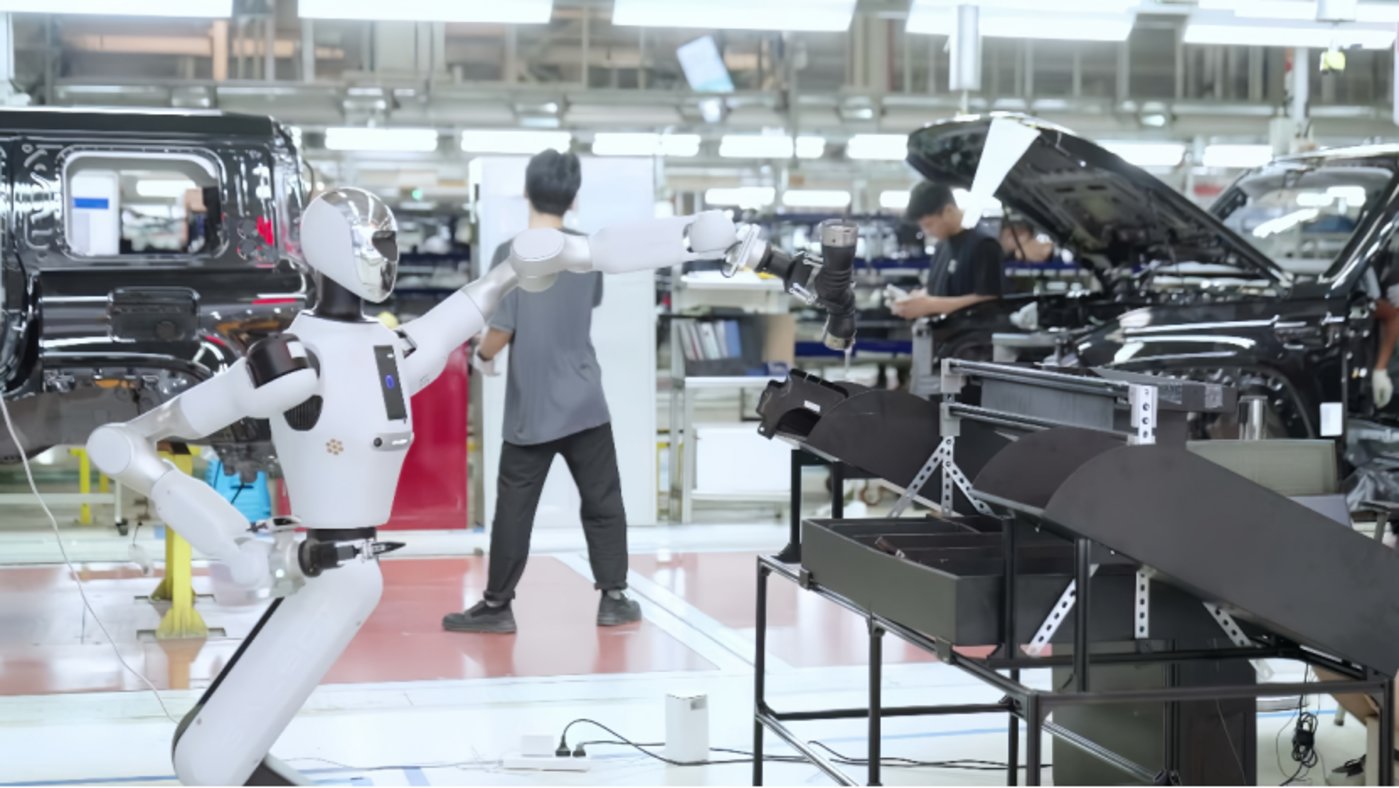
It has only released one main product, Galbot (G1), which adopts a "wheeled chassis+folding legs" design instead of the industry's mainstream bipedal walking solution. The robots of this company are mainly used for two things: picking medicine in unmanned pharmacies 24 hours a day and operating 24/7 for over a year; In the factories of CATL, Bosch, and Toyota, the cumulative orders have reached thousands of units.
The company plans to open a total of 100 unmanned retail stores in cities such as Beijing, Shanghai, and Shenzhen this year. At present, this application scenario has been commercialized and is expected to bring nearly 100 million yuan in revenue to Galaxy General Motors this year.
Why do "less complex" scenes actually win? What is the business logic behind this?
At a 24-hour unmanned pharmacy in Chaoyang District, Beijing, the wheeled dual arm robot Galbot is performing night shift tasks. In a space of 50 square meters, he manages 5000 types of goods, 6000 cargo lanes, and over 10000 boxes of medicine. Inventory, replenishment, pick-up and delivery, and packaging are repetitive tasks that robots can complete 24/7 without interruption.
This is the world's first humanoid robot intelligent retail solution released by Galaxy General in March 2025. Deploying a single new store only takes one day, which has impressed many retailers with its efficiency. As of June, nearly ten stores in Beijing have achieved deployment and regular operation, and it is planned to be put into use in 100 stores nationwide within the year.
But retail is only a corner of the general commercial map of Galaxy. The larger market is in the field of industrial manufacturing.
On June 17, 2025, Galaxy General Motors announced the establishment of a joint venture with Bosch Capital, a subsidiary of global industrial giant Bosch Group, and signed a tripartite strategic memorandum with Bosch China and Bosch Capital. This collaboration focuses on industrial manufacturing scenarios and aims to jointly promote the commercialization of embodied intelligent robots in the global market. Previously, Galaxy General Motors had established cooperative relationships with industry giants such as CATL, Toyota, and Hyundai, and had accumulated thousands of industrial orders.
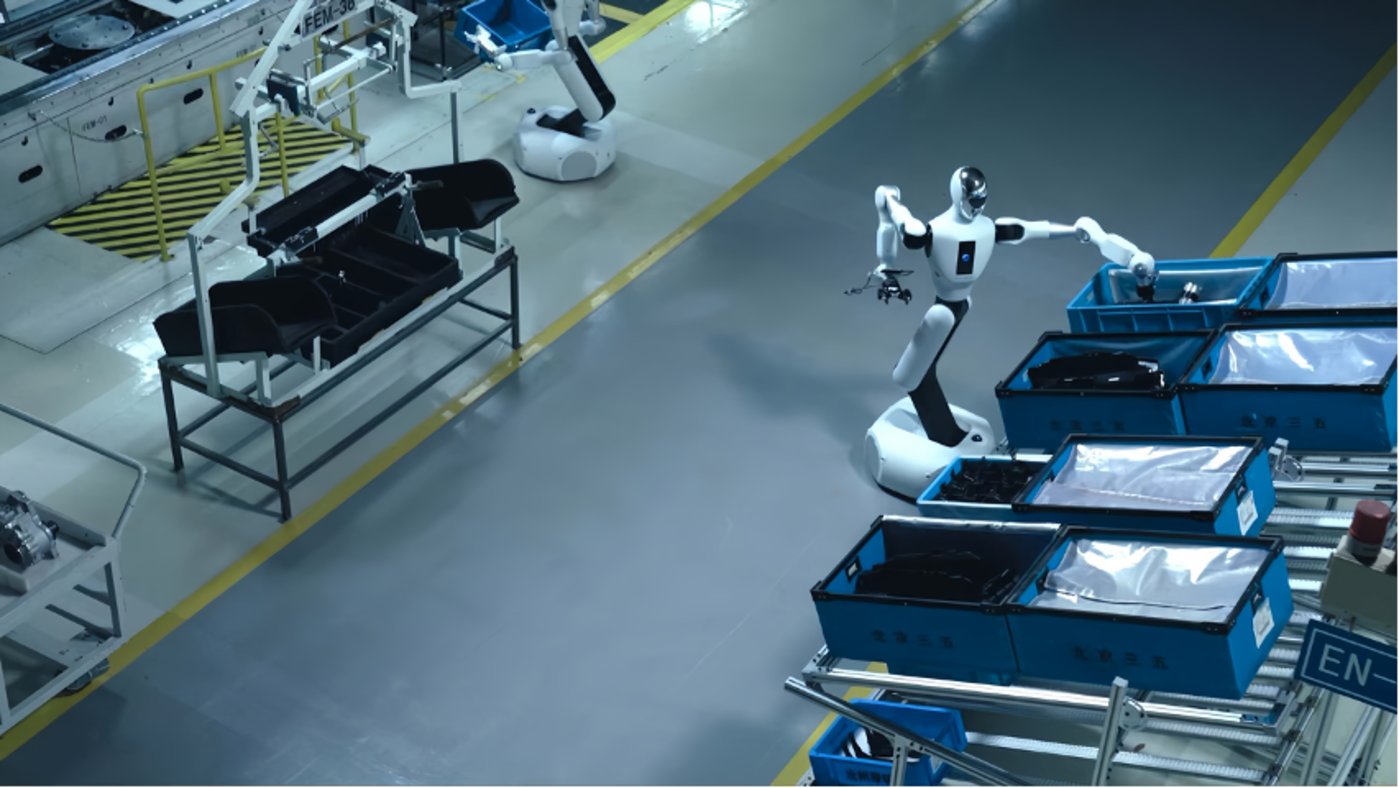
Behind these numbers is a clear logic of scene selection: Galaxy General focuses on tasks such as "Mobile, Pick, and Place" that may seem simple but are actually high-frequency and essential.
We don't pursue robots to do 100 things, but to make them meet industrial standards for 10 things, "said Wang He, founder of Galaxy General Motors and a post-90s professor at Peking University, in an interview.
This restraint is precisely the core of the "laying eggs along the way" strategy. Laying eggs along the way "refers to enterprises relying on their current technological capabilities to achieve commercial delivery in specific scenarios before the ultimate goal of general artificial intelligence is achieved, using product revenue to support research and development investment, and forming a" hematopoietic ability ".
This is completely different from the traditional "financing first, commercialization later" path of technology entrepreneurship. In the field of humanoid robots, the investment of billions of dollars in research and development, long technological iteration cycles, and uncertain commercialization timelines make the "pure money burning" model unsustainable.
Up to now, Galaxy General Motors has only released one main product Galbot G1, but has launched multiple large models with specific bodies. The founder of Galaxy General Motors, Wang He, once said, "As a embodied large model company, our biggest investment is still in the research and development of models." This sentence reveals the company's strategic choice to focus on the "brain" (embodied large models) rather than the "body" (ontology hardware), first establishing a foothold in pharmacies, factories, retail warehouses, and other scenarios, and then expanding into more complex universal scenarios.
Wang He's statement at the 2025 Zhongguancun Forum clearly outlines the underlying logic of this strategy. He believes that humanoid robots are moving from the "sports era" to the "productivity era", and the key is not how fast or high the robot can run, but how to achieve hand eye brain coordination. We have cultivated athletes without visual input, but athletes are definitely not the end of humanoid robots, "he emphasized." No work is done with eyes closed.
Not so complicated, but actually the optimal solution
On the track of humanoid robots, a counterintuitive phenomenon is happening: companies that focus on "simple scenarios" are actually gaining more capital recognition and commercial orders.
Galaxy General can quickly land in multiple scenarios, and its core competitiveness lies in its self-developed embodied end-to-end large model technology.
The traditional robot adopts the separation design of "vision+trajectory planning", and the technology path of Galaxy Universal subverts this model. The company's self-developed embodied end-to-end large model integrates autonomous real-time mapping and navigation, intelligent voice interaction, task understanding, and other capabilities, allowing Galbot to efficiently complete operations without the need for preset paths.
In June 2025, the company released the GroceryVLA&TrackVLA models, the former of which achieved zero sample generalization and capture of all retail product categories; The latter achieves high robustness in following complex dynamic human flows.
More importantly, Galaxy General adopts a unique synthetic data training method. 90% of the company's training data is virtual simulation, which can generate a billion level operation dataset in just one week, at a cost of only 1/100 of real data. The algorithm architecture is divided into grasping model, ontology model, and perception model, using a fast slow system and A100 chip for training. 50-60 million yuan of computing power is invested annually to achieve a large model iteration every 2-3 months.
Released in November. The world's first cross ontology navigation model NavFoM enables robots to have long-range autonomous navigation capabilities across indoor and outdoor environments without the need for mapping.
We also released the DexNDM model for the neural dynamics of dexterous hands, which solves the algorithmic gap in fine operations such as screwing and hand rotation, and achieves motion control based on training rather than pre programming.
This path selection of "heavy software, light hardware" stems from Wang He's judgment of the nature of the industry. As a large-scale modeling company, our biggest investment is still in the research and development of models. The cost of computing power accounts for a large proportion, "he revealed in a media interview. Galaxy General Motors is building a high-quality dataset worth billions of yuan, and through continuous operation in real scenarios, forming a closed loop of" data model application ".
Why doesn't Galaxy General take on more complex home scenarios and instead focus on pharmacies, warehouses, and factories?
The answer is hidden in the 'technology maturity curve'
The home environment is the ultimate goal of humanoid robots, but the technological challenges behind it are far beyond imagination. According to industry research institutions' estimates, in order for robots to reach a basic usable level in home scenarios, they need to recognize and operate over 10000 different objects, from fragile glass cups to soft towels, from regular books to irregular toys. Each object has different materials, weights, and grasping methods.
More importantly, the placement of objects in family scenes is highly random, with complex and varied lighting conditions and severe background interference. A perfectly trained grasping algorithm in the laboratory may not even recognize a water cup placed in the shadow in a real home.
In contrast, the advantages of "simple scenarios" are obvious. Factory production lines, warehouse shelves, and pharmacy cabinets are standardized and structured spaces where robots can be repeatedly trained in relatively fixed environments.
Taking the deployment of Galaxy General in Beijing pharmacies as an example, with a space of 50 square meters, 6000 fixed cargo lanes, and standardized lighting conditions, these parameters are consistent in each store. The robot only needs to be trained once and can be reused in all similar stores.
In the factory of Ningde Times, Galaxy General's robots repeatedly perform skylight transportation tasks every day, providing training data for the algorithm with each action. In just three months, the success rate of robots on this specific task has increased from 85% to 98%, a rapid iteration that is almost impossible to achieve in home scenarios.
But 'simplicity' does not mean 'low technical content'. The universal NavFoM navigation model in the Milky Way can achieve hourly long-range navigation and dynamic obstacle avoidance; DexNDM Smart Hand Model supports precise operations such as manual rotation, screw tightening, and table leg repair. These abilities have reached industrial grade standards.
From the perspective of technological evolution, the improvement of humanoid robots' capabilities can be divided into three stages:
Can do (Lv1-Lv2): Complete a certain action in the laboratory. Currently, about 70% of projects worldwide are in this stage.
Stable operation (Lv2-Lv3): Complete tasks for a long time, with high frequency and low failure rate in real scenarios. This is the key threshold for commercialization, and currently less than 10% of enterprises have reached this level.
Generalization (Lv3-Lv5): Adapt to different environments, tasks, and requirements. This is the ultimate goal of general artificial intelligence, expected to take over 10 years.
At present, most humanoid robots are still in the first stage. Galaxy General is moving towards the second phase by focusing on "simple scenarios", which is a necessary path towards commercialization. Only when robots can operate stably in factories, warehouses, and pharmacies can they accumulate sufficient technical capabilities and data resources to challenge more complex home scenarios.
This evolutionary path is not unfamiliar in the history of technology. The development of the Internet has also gone through a similar process: in the 1990s, the Internet was first used in ToB scenarios such as enterprises and universities (email, file transfer); It was not until the 2000s when technology matured and costs decreased that it entered households on a large scale, giving rise to the prosperity of To C. Humanoid robots are likely to follow the same logic.
The evaluation of Wang Huadong, a partner at Jingwei Venture Capital, confirms this point: "The team has achieved large-scale commercial delivery in multiple core scenarios, fully verifying the practicality and reliability of the technology. This positive cycle of 'technology landing iteration' is exactly the core capability that we value most when investing
A valuation of 20 billion yuan is a report card of Galaxy General's pragmatic approach, and also sets a watershed for the entire humanoid robot industry. After that, the competition will no longer be about cool demos, but about real orders, revenue, and profits.