The competition for computing power and intelligence in the field of artificial intelligence is entering a white hot stage with the exposure of new models in top laboratories. On March 29, 2026, according to media reports citing leaked documents within Anthropic, the highly anticipated next-generation super model Claude Mythos has now entered a secret testing phase. This leaked blog draft not only showcases the powerful performance of the model, but also triggers a new round of discussions about AI security, shaking the entire industry.
Leakage incident: An industry earthquake triggered by a document
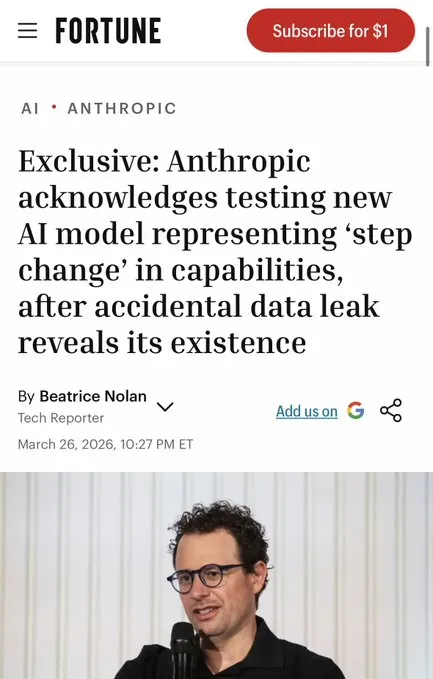
The source of this leak is an internal blog draft from Anthropic, which detailed the development progress and performance of the new generation model. From the timing of the leak, Anthropic chose to conduct internal testing in late March, which is intriguing - just a few days ago, OpenAI announced a strategic contraction, shutting down the Sora video model and suspending ChatGPT adult mode development.
Anthropic seems to be sending a clear signal to the market: while competitors are shrinking their front lines, we are advancing the next generation of breakthrough technologies. This' you back me in 'situation makes the already fierce competition among big models even more dramatic.
The core content of the leaked files includes: the new model has entered the testing phase, outperforms the existing flagship Claude Opus in performance, and brings unprecedented security risks. The disclosure of this information, whether intentional or unintentional, has already had a huge impact within the industry - competitors must reassess their technology routes, investors need to recalculate valuation models, and users are full of expectations for "stronger AI".
Technological Breakthrough: The Transition from "Opus" to "Capybara"
The leaked documents revealed a brand new model hierarchy naming - Capybara. This level represents the most groundbreaking technological leap in Anthropic's history, and its significance goes far beyond a simple version iteration.
From the perspective of technological evolution, Claude's product line has always adopted a unique naming system: Haiku (fast and lightweight), Sonnet (balanced and versatile), Opus (flagship and strongest). The emergence of Capybara signifies that Anthropic is defining a new level of 'super flagship'. The document clearly states that Capybara corresponds to a new level with a larger scale and higher level of intelligence, and its comprehensive capabilities have surpassed the Claude Opus model, which was previously regarded as the industry benchmark.
Internal information shows that Capybara and Mythos are likely referring to different representations of the same underlying architecture. This change in naming strategy reflects Anthropic's positioning of the new generation model - not just 'stronger', but 'qualitative'. The true value of Mythos lies in its ability to evolve from conversational skills to deeper levels of logical reasoning and complex task processing.
Compared with its competitors, Anthropic's technological roadmap has distinct characteristics. Unlike OpenAI's pursuit of comprehensive coverage of universal capabilities, Anthropic places greater emphasis on model controllability and security, which gives it a unique advantage in the enterprise market. The emergence of Mythos means that Anthropic is seeking a new balance between "security" and "power" - breaking through the smart ceiling while maintaining the bottom line of security.
Industry pattern: The big model echelon is facing a reshuffle
As OpenAI's strongest competitor, Anthropic's new model undoubtedly dropped a bombshell on the entire industry. The emergence of Claude Mythos means that the baseline for large model capabilities will be significantly raised again.
The competitive landscape is undergoing profound changes. In the past two years, OpenAI's GPT series has been regarded as the industry benchmark, and various models are aligning with GPT-4. But the emergence of Claude Opus has already broken this pattern, and the upcoming release of Mythos may completely change the industry narrative - the strongest model is no longer GPT, but Claude.
The impact of this change is multidimensional. For enterprise users, stronger models mean more complex tasks can be automated, further enhancing business value. For developers, new capability boundaries mean new application scenarios and the opening of innovation space. For investors, the transfer of technological leadership means a restructuring of valuation logic.
More importantly, the emergence of Mythos may accelerate the "Matthew Effect" in the industry. As the gap in the capabilities of the strongest models widens, the cost of catching up with the laggards will sharply increase. This may lead to an increase in market concentration, with a few companies with top models occupying the majority of the market share.
Security Concerns: Unprecedented Network Security Risks
With the soaring level of intelligence, Anthropic has expressed high vigilance towards the potential demonstrated by Claude Mythos internally. According to leaked documents, the company believes that the model poses unprecedented cybersecurity risks.
This risk warning is not an exaggeration. When the intelligence level of AI reaches or exceeds that of human experts, its potential danger also amplifies. A sufficiently powerful AI model may be used to write malicious code, discover system vulnerabilities, generate phishing emails, and even conduct social engineering attacks. These abilities are valuable tools in the context of 'helping users', but they are dangerous weapons in the hands of malicious users.
Anthropic's risk assessment also explains why the company remains cautious in its release pace. Unlike OpenAI's pursuit of rapid iteration, Anthropic has always emphasized "responsible AI development", attempting to find a more stringent balance between pursuing "strongest intelligence" and "human safety". This strategy may mean slower release speeds in business, but may mean more controllable risks in security.
For the entire industry, Anthropic's security considerations have demonstrative significance. When AI capabilities surpass a critical point, security issues are no longer just an added bonus, but a core issue of life and death. How to ensure safety and controllability while enhancing capabilities will become a common issue that all top AI laboratories must face.
Future Development: Searching for the "Mythical" Boundaries of AI
Although the official release date of Claude Mythos has not yet been confirmed, the outline of "stronger intelligence" is clearly visible. Based on the information revealed in the leaked documents, it is highly likely that Anthropic will complete testing and be officially released in the first half of 2026.
In the short term (3-6 months), the release of Mythos will trigger a new round of model capability competition. OpenAI is bound to respond, possibly accelerating the development of GPT-5 or adjusting its release strategy. Google may also adjust Gemini's development path. The entire industry will enter a new stage of 'chasing after each other'.
In the long run (1-3 years), the sustained breakthroughs in AI intelligence will have far-reaching impacts. When models are able to handle increasingly complex tasks, the way humans and AI collaborate will undergo fundamental changes. More decision-making, creative, and research work will be led or assisted by AI, and human roles will shift from "executors" to "supervisors" and "direction setters".
But risks and opportunities coexist. When the intelligence level of AI begins to surpass the cognitive boundaries of humans in the past, how to harness this power will become a common issue faced by Anthropic and even global technology giants. Technological breakthroughs are only the first step, the real challenge is how to make powerful AI safely serve humanity.
We will wait and see if Claude Mythos' myth can be safely implemented.