On March 10, 2026, OpenAI announced the launch of a highly innovative feature for ChatGPT called "Dynamic Visual Explanations". The introduction of this feature was like a stone thrown into a calm lake, causing ripples in the field of education.
Breaking Tradition: Interactive Transformation from Static to Dynamic
The traditional interaction mode of artificial intelligence is mostly limited to the display of text and static charts. When users acquire knowledge, they often can only understand abstract concepts through textual descriptions and fixed charts. This one-way knowledge transmission method is difficult to understand for some complex mathematical and chemical knowledge. The "dynamic visual interpretation" function of ChatGPT has achieved a significant leap from static to dynamic.
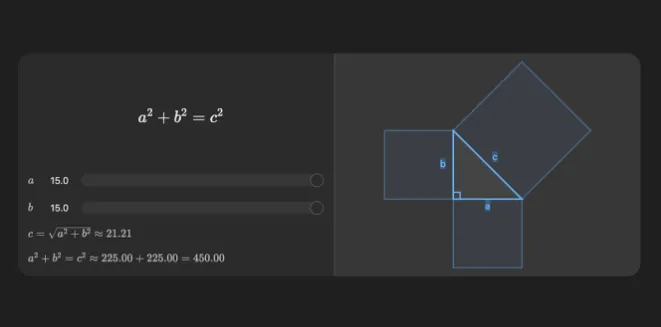
This feature allows users to manipulate variables and observe changes in the relationship between mathematical formulas and science in real time. Taking the Pythagorean theorem as an example, when the user adjusts the length of the two right angled sides of a right angled triangle, the screen will instantly display the corresponding change in the length of the hypotenuse, and the geometric shape will also dynamically adjust accordingly, allowing the user to intuitively see the relationship between the three. For example, in the lens equation, users can immediately see changes in imaging conditions by changing parameters such as object distance, image distance, or focal length. This real-time interactive experience greatly enhances users' intuitive perception of complex logic.
Wide coverage: covering over 70 core academic topics in one go
The "Dynamic Visual Interpretation" feature launched this time is not limited to a few knowledge points, but has a wide coverage.
At present, this interactive module has covered over 70 core academic topics, including Ohm's Law, Coulomb's Law, compound interest calculation, and binomial square. Whether it is electrical and optical knowledge in physics, algebra and geometry in mathematics, or basic computational principles in economics, this function can be used for real-time interactive display.
This broad coverage enables learners from different disciplines and levels to benefit from it. For beginners, they can quickly establish a basic understanding of abstract concepts through dynamic visual presentations; For learners with a certain foundation, they can deepen their understanding and mastery of knowledge by delving into the relationships between different variables.
Moreover, this feature is open to all logged in users without additional payment or special permissions, providing a fair and convenient learning platform for learners.
Educational layout: Building a complete AI teaching ecosystem
The launch of the "Dynamic Visual Interpretation" feature is a crucial step for OpenAI to deepen its layout in the field of education. According to official data, over 140 million users use ChatGPT to assist in learning mathematics, physics, and chemistry every week, providing a solid foundation for OpenAI's development in the field of education.
Prior to this, ChatGPT had already launched features such as "Learning Mode" and QuizGPT, which, in conjunction with "Dynamic Visual Interpretation," jointly built a more complete AI teaching ecosystem.
The 'learning mode' can provide personalized learning advice and materials based on the user's learning progress and needs;
QuizGPT can help users consolidate their learned knowledge by generating various types of practice questions;
The "Dynamic Visual Interpretation" function allows users to better understand abstract concepts through real-time interactive visualization.
The three complement each other, forming a complete learning chain from knowledge input to understanding consolidation and then to application expansion.
Industry Competition: From "Answer Providers" to "Interactive Mentors"
In the field of generative AI, competition is becoming increasingly fierce. Just before OpenAI launched its "Dynamic Visual Interpretation" feature, Google's Gemini had already launched a similar visualization tool in November last year. This competitive situation has prompted major technology companies to continuously increase their investment in technology research and innovation, and has also driven the rapid development of generative AI in the field of education.
The transition from the role of "answer provider" to "interactive mentor" is an important trend in the development of generative AI in the field of education. The traditional online education model often involves teachers imparting knowledge unilaterally and students passively receiving it. The emergence of generative AI enables students to actively participate in the learning process and explore the mysteries of knowledge through interaction with AI. This immersive exploration experience transforms traditional one-way knowledge transmission into two-way interactive communication, which helps stimulate students' interest and enthusiasm for learning.
However, we should also be aware that although functions such as "dynamic visual interpretation" provide students with more intuitive and vivid learning methods, their actual conversion rate to deep understanding still needs further observation and verification by the education sector. Learning is a complex process that relies not only on visual displays, but also on students' thinking, analysis, and summarization. Therefore, in the process of using generative AI assisted learning, we cannot ignore the role of traditional teaching methods, and should organically combine the two to achieve the best learning effect.
The "Dynamic Visual Interpretation" feature of ChatGPT has brought new opportunities and challenges to online education. It provides learners with a better learning experience with its innovative interactive methods and broad application prospects. With the continuous advancement and improvement of technology, it is believed that generative AI will play a greater role in the field of education, promoting the development of online education towards a more intelligent and personalized direction.