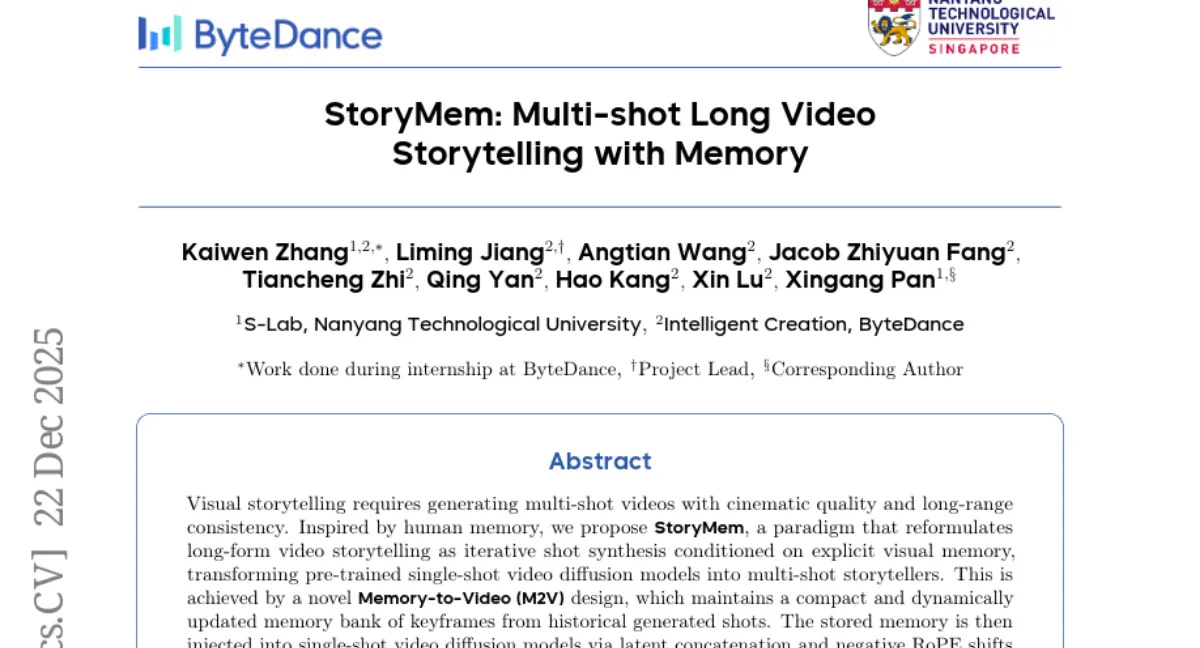
Recently, the StoryMem system, jointly developed by ByteDance and Nanyang Technological University, has been officially unveiled. This system precisely addresses the industry pain point of inconsistent appearance across scenes and roles in AI video generation. Its cross-scene consistency performance has improved by 28.7% compared to the basic model, marking a significant technological breakthrough in the field of AI creation.
Currently, mainstream AI video generation models such as Sora, Kling, and Veo excel in short-segment creation. However, in AI creation scenarios where multiple scenes are stitched together to form a complete story, they generally encounter issues such as sudden changes in character appearance and disruptions in environmental logic. Previous solutions either require a significant investment of computational resources or struggle to balance generation efficiency and consistency, becoming a key obstacle to the large-scale application of AI video. This also poses technical limitations for many AI creation practitioners participating in AI creation competitions and other scenarios.

The StoryMem system achieves a key breakthrough through its unique technical design, with its core logic revolving around "memory and reference":
1.Key frame intelligent management: During the video generation process, the system will automatically filter out visually important frames and store them in memory, ensuring both memory usage efficiency and the complete preservation of core visual information at the beginning of the story;
2.Model adaptation and optimization: Utilizing Low-Rank Adaptation (LoRA) technology, we have successfully adapted Alibaba's open-source model Wan2.2-I2V, thereby lowering the threshold for technology implementation;
3.Targeted Training Scheme: The research team utilized 400,000 video clips, each lasting 5 seconds, as training data and grouped them based on visual similarity for training, enabling the model to generate sequels with a unified style.
Targeted Training Scheme: The research team utilized 400,000 video clips, each lasting 5 seconds, as training data. They grouped the clips based on visual similarity for training, enabling the model to generate sequels with a consistent style.
This innovative mechanism enables AI video generation to achieve coherence and unity between characters and the environment while maintaining creative flexibility, providing technical support for the application of AI intelligent assistants in video creation scenarios.
Technical prowess needs to be supported by data and market feedback: In official tests, the cross-scenario consistency of the StoryMem system has improved by 28.7% compared to the unmodified baseline model, demonstrating significant technical advantages. In user surveys, participants generally prefer the generated results of StoryMem, believing that it excels in both visual aesthetics and content consistency. This result also makes the system a promising candidate for popular recommendation in AI tool navigation.
Despite its outstanding performance, the StoryMem system still has certain limitations: in complex scenes involving multiple characters, there may be situations where the visual characteristics of characters are not applied appropriately. The research team suggests that users should explicitly describe the characteristics of characters in each prompt when using the system to further enhance the generation effect. This suggestion also provides a reference for the practical implementation of technology in the dynamic AI industry.
As a significant technological innovation in the field of AI video generation, the launch of the StoryMem system not only addresses the core pain points of the industry but also drives the development of AI creation towards longer stories and multiple scenarios, injecting new vitality into the dynamics of the AI industry. In the future, with the continuous optimization of technology, its application scenarios in the AI tool ecosystem will be further expanded.