On January 13, 2026, the AI star company Anthropic officially released its new product Claude Cowork, expanding the Claude Code capability originally intended for developers to all ordinary users. This tool, known as the "civilian version AI assistant," can directly access the user's computer file system and automatically handle complex office tasks such as document organization, data extraction, and batch file operations without any programming knowledge. At present, this feature is open to Claude Max subscribers on the macOS platform in the form of a research preview, marking the official transition of AI office collaboration from a "conversation assistant" to a "digital colleague" stage.
The birth of Cowork originated from an unexpected discovery. After Anthropic launched the Claude Code tool for developers last year, the team quickly noticed that users did not limit it to programming scenarios. On the contrary, a large number of users have started using it to organize travel guides, create presentations, clean emails, recover hard drive data, and even monitor plant growth and control smart appliances. The spillover effect of this usage scenario prompted Anthropic to make a key judgment: since AI has been used as a work partner, why not provide everyone with truly intelligent collaboration tools for daily office work?
Claude Code creator Boris Cherny announced the release of Cowork on social media, saying, "These application scenarios are diverse and surprising - because the underlying Claude Agent is the best agent, and Opus 4.5 is the best model. Today we are launching Cowork, which enables Claude Code to serve all non coding work
Claude Cowork's core breakthrough lies in changing the paradigm of human-computer interaction. In traditional dialogue mode, users need to repeatedly provide contextual information, manually organize files, and manually convert output formats. In Cowork, users can directly grant Claude access to specified local folders, and AI can read, edit, and create files within the authorized scope.
Key features include:
Precise permission control: Users can select authorized folders one by one, and Claude can only access directories that are explicitly allowed, without touching any unauthorized content, ensuring data security and controllability.
Autonomous task planning: After receiving instructions, Claude will disassemble the execution steps, plan the path, and continuously synchronize progress during the process. Users can insert new feedback or supplement ideas without waiting for the task to be completed.
Parallel task processing: Supports task queuing and multi-threaded execution, allowing users to continuously assign multiple tasks, and the system automatically queues for parallel processing, which conforms to the multitasking characteristics of real work scenarios.
Browser automation: When used in conjunction with Chrome browser, Claude can complete tasks that require accessing web pages, further expanding application boundaries.
According to IT Home, Cowork makes human AI interaction "more like leaving a message to a real colleague" rather than the traditional back and forth conversation mode. This design concept reflects Anthropic's profound understanding of the essence of office collaboration.
From file organization to data extraction
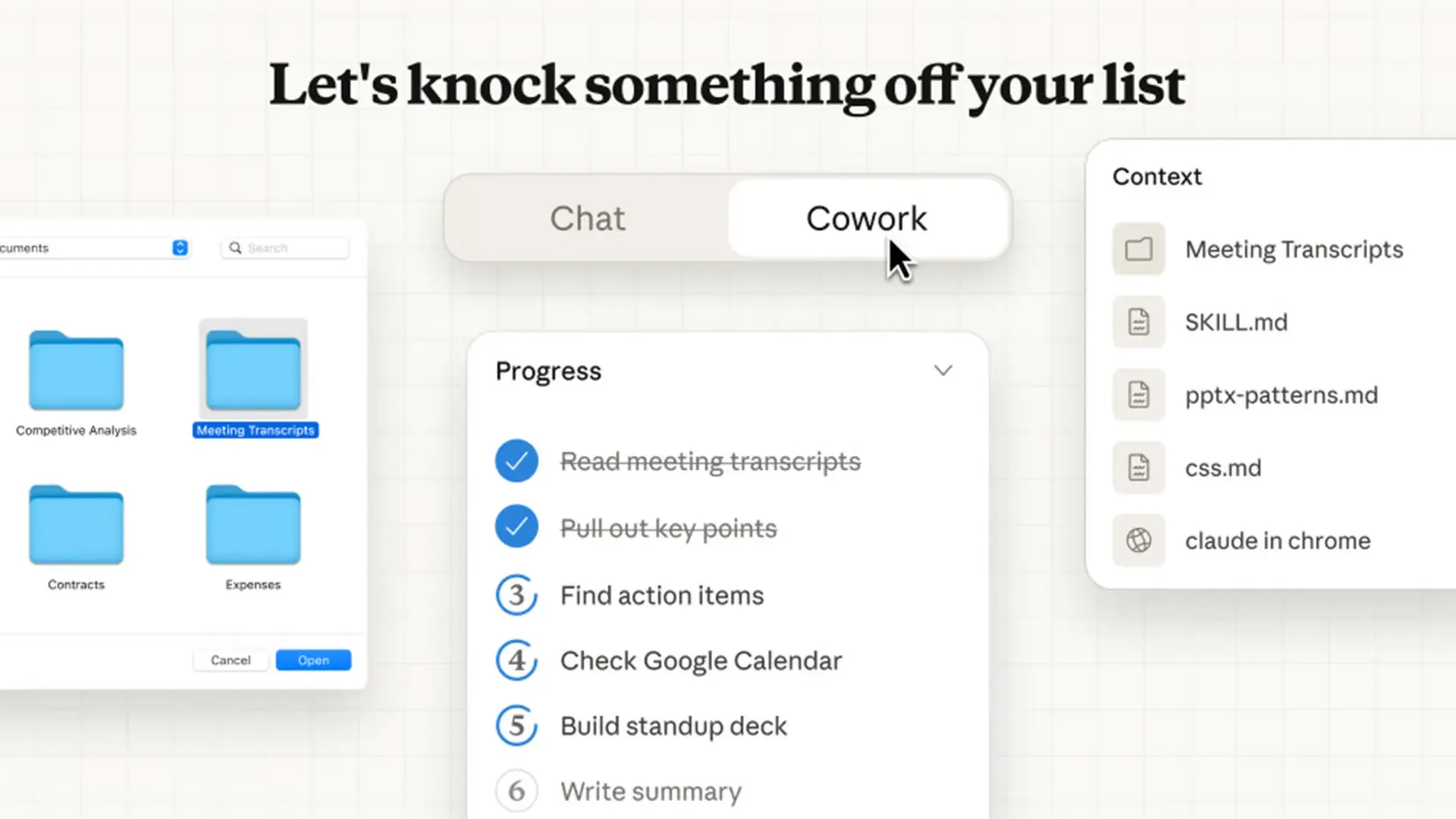
Cowork has demonstrated strong productivity value in multiple practical scenarios:
Batch file management: Scan cluttered download folders, automatically classify and rename them by type, time, or purpose, without the need for manual operation one by one.
Information extraction and integration: Extract key information from a large number of screenshots, PDFs, or meeting minutes to automatically generate structured expense lists, summary reports, or data tables.
Document creation optimization: Organize scattered notes and draft fragments into logically clear formal documents, and combine them with the newly added office skills module to output formats that are closer to professional standards.
Web data scraping: Through browser automation functions, specific website information is collected in batches and converted into usable formats, suitable for market research, competitor analysis, and other scenarios.
Multimedia processing: calling tools such as ffmpeg to perform video batch transcoding, image format conversion, and other operations, even non-technical users can easily complete them.
Industry observers point out that the launch of Cowork may reshape the daily processes of knowledge workers, especially those who frequently handle files and information such as content creators, product managers, operations personnel, and administrative staff.
Allowing AI to directly operate file systems undoubtedly brings about a leap in capability, but it also comes with an escalation of risks. Anthropic attaches great importance to this in product design and has established multiple layers of security protection mechanisms.
Operation confirmation mechanism: Before performing any destructive and important operation (such as deleting files, batch modifications), Claude will actively seek user confirmation to avoid irreversible consequences caused by misoperation.
Built in virtual machine isolation: The system performs operations in an isolated environment by default, reducing the potential impact of risks on the overall system.
Defense prompt injection: Claude may encounter malicious embedded instructions when processing content from the Internet. Anthropic has built a multi-layer defense system against prompt injection attacks. Although the team admitted that "proxy security" is still the forefront of the industry's exploration.
Clear usage advice: The official repeatedly reminds users to provide clear and specific instructions when high-risk operations are involved, avoiding reliance on vague natural language. At the same time, it is recommended to maintain necessary manual review for critical tasks.
Anthropic emphasizes that these security challenges are not unique to Cowork, but rather common issues that all AI tools with "operational capabilities" must face. As a research preview, Cowork accelerates the iterative improvement of security mechanisms through real user feedback.
Expectations and controversies coexist
After the release of Cowork, it quickly sparked a heated discussion in the developer community and AI product circle, shifting the focus from model scoring to more realistic questions: "Has AI really begun to become a trustworthy and authorized participant in work? "
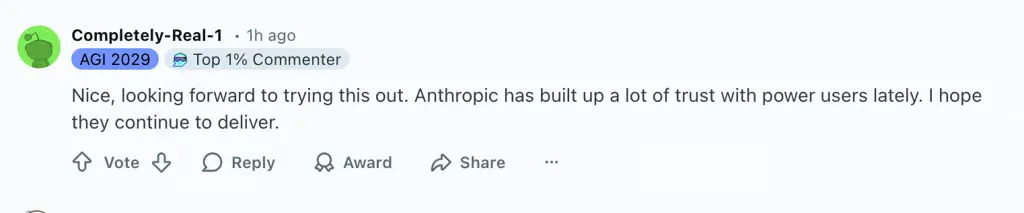
In terms of positive reviews, Reddit users expressed their "eagerness to try this feature" and believed that Anthropic has performed well in product and user trust building recently. Many users have praised it as having the potential to reshape the way white-collar workers work, and even predicted that it would have an impact on the traditional office software market.
Controversy and dissatisfaction are equally evident. The biggest criticism focuses on platform limitations - currently only supporting macOS and requiring a Claude Max subscription. A large number of Windows and Linux users have expressed strong dissatisfaction, with "not supporting Linux, negative reviews" becoming a frequent comment on social media platforms. Some long-term users have expressed disappointment with Anthropic's recent decline in product strategy and communication transparency.
From the perspective of product maturity, Cowork as a research preview version is not yet fully functional. The official plan is to introduce improvements such as cross device synchronization, Windows platform support, and more enhanced security mechanisms in the future. Anthropic adopts a progressive open strategy, which is both technically prudent and responsible to users.
The launch of Cowork is of symbolic significance, representing the evolution of AI applications from "auxiliary tools" to "collaborative partners". Unlike conversational AI such as ChatGPT and Copilot, Cowork has built a new human-machine collaboration model by directly embedding it into the user's work environment, actively planning task execution, and supporting parallel multi-threaded processing.
Compared to Claude Code, the two share the same underlying architecture, but Cowork repackages complex capabilities into non-technical user-friendly interaction methods, greatly reducing the threshold for use. This "ability sinking" strategy may indicate the path of popularization of AI tools: first serve professional populations to verify feasibility, and then benefit the mass market through productized packaging.
Compared to traditional office software, Cowork no longer relies on pre-set functional modules and fixed workflows, but instead uses natural language to understand user intent and flexibly combine system capabilities to complete tasks. This paradigm shift may pose long-term challenges to traditional office suites such as Microsoft Office and WPS.
Industry analysis believes that as Cowork expands to more platforms and security mechanisms are further improved, AI's deep involvement in daily office work will become an irreversible trend. The core value of knowledge workers will shift from "performing repetitive tasks" to "defining goals, reviewing results, and making judgments", and the boundaries of human-machine collaboration are being redefined.